The Legislative Branch: Congress
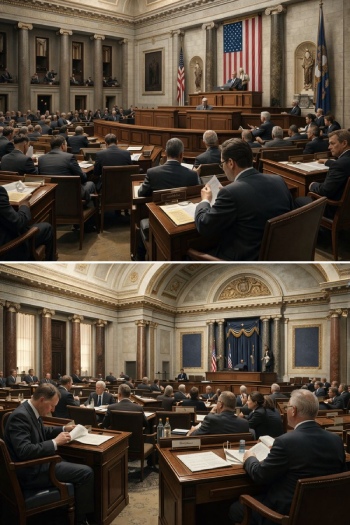
The legislative branch, primarily embodied in Congress, is responsible for creating federal laws. Congress is bicameral, consisting of the House of Representatives and the Senate. This dual structure ensures representation of both population size and state equality, allowing for a balance between citizens' interests and state sovereignty.
Congress's authority is defined by the U.S. Constitution, which grants it powers such as taxation, budget allocation, regulation of commerce, and declaring war. The legislative process involves drafting bills, committee review, debate, and voting, with bills requiring approval from both chambers before reaching the president for signature.
The House of Representatives
The House represents the population, with seats apportioned based on state population. Members serve two-year terms, reflecting an emphasis on responsiveness to constituents. The House initiates revenue-related bills and can impeach federal officials, including the president. Its committees review legislation, oversee agencies, and hold hearings to ensure accountability.
The Senate
The Senate is the only chamber having equal representation among all states, where a pair of senators gets a term of six years each. The Senate has some of its powers unique to itself, such as ratifying treaties and confirming presidential appointments while trying to impeach a president. Senators typically have a more long-term focus on policy while requiring more agreement between the two chambers on legislation, providing a check on the House.
The Executive Branch: The President and Federal Agencies
The executive branch enforces federal laws and manages the administration of government programs. The president, as head of state and government, is responsible for executing laws passed by Congress, directing foreign policy, and serving as commander-in-chief of the armed forces. The executive branch includes the vice president, the president's cabinet, and numerous federal agencies.
Agencies and departments implement laws through regulations, programs, and public services. For example, the Department of Health and Human Services oversees public health initiatives, while the Department of Education manages federal education programs. This branch also coordinates emergency response, economic policy, and regulatory enforcement.
The President and Vice President
The president is elected through the Electoral College for a four-year term, with a maximum of two terms allowed. Responsibilities include signing or vetoing legislation, issuing executive orders, and appointing federal judges and agency heads. The vice president supports the president, presides over the Senate, and can assume the presidency if necessary.
Federal Agencies and the Cabinet
The president's cabinet consists of department heads and key advisors who oversee specialized areas of governance. Independent agencies, commissions, and boards operate under the executive branch but often have some degree of autonomy to ensure objective administration. These institutions translate policy into action, provide services, and regulate specific sectors.
The Judicial Branch: Federal Courts
The judiciary interprets the law and ensures that they adhere to the constitution. It consists of a comprehensive network of federal courts led by the Supreme Court. The judiciary is a check on the activities of both the legislative and executive branches, settling disputes between them on the proper reach of laws, executive action and constitutional interpretation.
The judiciary is responsible for handling cases concerning federal and constitutional rights and conflicts between states. Reasoning and precedents are what the courts rely on to ensure that laws are applied consistenly. This ensures that governance remains equitable and stable.
The Supreme Court
The Supreme Court is the highest judicial body, with nine justices appointed for life terms. It reviews cases with broad constitutional significance, resolves disputes between states, and can strike down laws or executive actions deemed unconstitutional. Its decisions shape legal interpretation across all levels of government.
Lower Federal Courts
The federal court system includes district courts, which serve as trial courts, and circuit courts of appeals, which review decisions from district courts. These courts handle civil and criminal cases arising under federal law, ensuring the judicial branch can manage the volume and complexity of legal disputes nationwide.
Federalism: Division Between Federal and State Governments
Beyond the three branches, the U.S. government operates under a federalist system, dividing power between the national and state governments. States retain authority over areas such as education, transportation, and law enforcement, while the federal government manages national defense, foreign policy, and interstate commerce.
This division allows for local responsiveness while maintaining national cohesion. Interactions between state and federal authorities, such as cooperative programs or legal disputes, reflect the layered nature of governance in the United States.
Understanding the Federal Government's Structure
The U.S. federal government is structured to distribute power across three branches, each with distinct roles and responsibilities, while maintaining a federalist division with state governments. Legislative, executive, and judicial institutions interact through a system of checks and balances, ensuring accountability, fairness, and representation. This structure underpins the operation of government and shapes how laws are made, implemented, and interpreted.